Harmony Gold Mining (NYSE:HMY), Gammon Gold (NYSE:GRS) Tanzanian Royalty Exploration (AMEX:TRE) and Northgate Minerals (AMEX:NXG) closed Up on Wednesday as gold continues to break records on a daily basis recently.
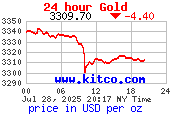
Gold prices soared to another intraday record, reaching as high as $1,506.20 an ounce before pulling back to settle for June delivery in at $1,498.90 an ounce, an increase of $3.80 at the Comex division of the New York Mercantile Exchange.
Wednesday was the fourth session in a row gold prices broke an intraday record, as well as settling at a new record as well.
After breaking the $45 level, silver prices ended the day up 54 cents to close at $44.46 an ounce. That was also another 31-year high as it pushes to break $50 and move on to an all-time record.
Gold and silver prices continue to soar on safe-haven buying with the major impetus at this time probably being a collapsing U.S. dollar. The U.S. dollar index was plunging 0.84% to $74.43 as it continues to struggle after Monday's S&P downgrade of the U.S. economy, and warning of a credit downgrade if the U.S. doesn't quit its outrageous spending and reduce its debt.
The downgrade of U.S. debt, sovereign debt crisis in Europe, Chinese inflation, soaring oil prices, and the ongoing fallout from the earthquake in Japan are just some of the other factors offer support to gold.
The gold-silver ratio, which measures how many silver ounces are needed to acquire an ounce of gold, fell under 34 — its lowest level since 1983.
Northgate Minerals closed Wednesday at $2.88, gaining $0.01, or 0.35 percent. Tanzanian Royalty Exploration closed at $6.32, up $0.02, or 0.32 percent. Gammon Gold ended the trading session at $10.78, rising $0.31, or 2.96 percent. Harmony Gold Mining closed at $15.02, jumping $0.24, or 1.62 percent.
Thursday, April 21, 2011
Gammon (GRS) (HMY) (NXG) (TRE) Close Up as Gold Breaks Record Again


Monday, April 18, 2011
Goldcorp (GG) (AU) (HMY) (UXG) Trade Mixed as Gold Climbs Toward $1,500
On Friday gold prices soared toward the $1,500 an ounce mark, trading as high as $1,488 an ounce in afternoon action until closing at $1,486.50 an ounce. AngloGold Ashanti (NYSE:AU), Harmony Gold Mining (NYSE:HMY), Goldcorp (NYSE:GG) and US Gold (AMEX:UXG) traded mixed as many gold miners pulled back after pushing up last week.
Inflation continues to be a major factor in gold price movement, as food and fuel prices in the U.S. continue to soar and consumer prices in China jump.
The ongoing weakness in the U.S. dollar, sovereign debt crisis in Europe and the unrest in the Middle East makes gold an attractive safe haven alternative for capital.
Goldcorp closed Friday at $54.18, gaining $0.22, or 0.41 percent. US Gold closed at $9.41, rising $0.04, or 0.42 percent. Harmony Gold Mining closed at $14.81, falling $0.09, or 0.60 percent. AngloGold Ashanti ended the session at $49.30, up $0.04, or 0.08 percent.
Hecla (HL) (AXU) (SSRI) (MGN) Trade Mixed as Silver Continues to Rise
Silver again hit new 31-year highs Friday soaring as high as $42.95 an ounce, closing the week up 4.9%. Silver for May delivery rose 90.7 cents to settle at $42.571 an ounce. Silver has risen just under 40 percent so far in 2011. Alexco Resource (AMEX:AXU), Silver Standard Resources (NASDAQ:SSRI), Hecla Mining (NYSE:HL) and Mines Management (AMEX:MGN) traded mixed on the day.
Gold prices roared toward the $1,500 an ounce mark, trading on Friday as high as $1,488 an ounce in afternoon action until closing at $1,486.50 an ounce.
Inflation continues to be a major factor in silver price movement, as it has with many precious and base metals, with food and fuel prices in the U.S. continuing to soar and consumer prices in China to climb.
The continuing collapse of the U.S. dollar, sovereign debt crisis in Europe and the unrest in the Middle East makes silver and gold an attractive safe haven alternative for capital.
Mines Management closed Friday at $2.71, plunging $0.17, or 5.90 percent. Hecla Mining closed at $9.61, gaining $0.08, or 0.84 percent. Silver Standard Resources closed at $33.80, dropping $0.18, or 0.53 percent. Alexco Resource ended the day at $9.64, losing $0.01, or 0.10 percent.
IAMGOLD (IAG) (NEM) (AZK) (GSS) Trade Mixed as Gold Climbs Toward $1,500
On Friday gold prices soared toward the $1,500 an ounce mark, trading as high as $1,488 an ounce in afternoon action until closing at $1,486.50 an ounce. Newmont Mining (NYSE:NEM), IAMGOLD Corporation (NYSE:IAG), Golden Star Resources (AMEX:GSS) and Aurizon Mines (AMEX:AZK) traded mixed as many gold miners pulled back after pushing up last week.
Inflation continues to be a major factor in gold price movement, as food and fuel prices in the U.S. continue to soar and consumer prices in China jump.
The ongoing weakness in the U.S. dollar, sovereign debt crisis in Europe and the unrest in the Middle East makes gold an attractive safe haven alternative for capital.
Newmont Mining closed Friday at $57.75, gaining $0.22, or 0.38 percent. IAMGOLD Corporation closed at $20.07, falling $1.85, or 8.44 percent. Golden Star Resources closed at $3.02, dropping $0.01, or 0.33 percent. Aurizon Mines ended the session at $6.78, down $0.11, or 1.60 percent.
Monday, December 27, 2010
Pan American Silver (Nasdaq:PAAS), Silver Wheaton (NYSE:SLW), Barrick (NYSE:ABX) and Goldcorp (NYSE:GG) Down on China's Interest Rate Hike
With the increasing importance of China as a global player, their decisions on interest rates are viewed as a bellwether, and that has pushed the share prices of Pan American Silver (Nasdaq:PAAS), Silver Wheaton (NYSE:SLW), Barrick Gold (NYSE:ABX) and Goldcorp (NYSE:GG) down as they raised their interest rates again.
The thing that has pushed the prices of a number of commodity companies down today is that the Chinese made this move quicker than anticipated, which gives the impression inflation is more of a challenge than believed, which could drive down the demand for raw materials in 2011.
Gold and silver are negatively affected by higher interest rates as well, which is why the decision by China has pressured the sector today.
Silver Wheaton dropped to $36.49, losing $0.25, or 0.68 percent, as of 2:23 PM EST. Pan American Silver was trading at $39.25, falling $0.79, or 1.97 percent. Barrick Gold dropped to $51.37, down $0.26, or 0.50 percent. Goldcorp fell to $44.28, down $0.47, or 1.05 percent.
Citigroup (NYSE:C), Morgan Stanley (NYSE:MS) and China Interest Rate Hikes
Citigroup (NYSE:C) and Morgan Stanley (NYSE:MS) are on the record as saying the People's Bank of China will continue to raise interest rate in 2011 to combat inflation.
Morgan Stanley projects three interest rate hikes of 25bp each in 2011, while Citigroup looks at an overall boost of 100bp on the year.
The People's Bank of China just raised their interest rate again, this time by 25 basis points to 5.81 percent; that's for its benchmark one-year rate.
For the one-year deposit rate, that was increased to 2.75 percent.
In November, China's inflation rate surged to 5.1 percent, reaching its highest level in over two years.
As for China's M2, that has increased 55 percent over the last couple of years.
For all of 2010, inflation should end at 3.3 percent in China, above the 3 percent policymakers were looking for.
Wednesday, December 8, 2010
Gold Prices Today Plunge on China Tightening Expectations
The volatility connected to gold prices continues as they fell again today, this time on worries over how far China will go to battle its inflation challenges. Gold prices today have plummeted on the concerns, with spot gold down by $17.40, to $1,383.70 an ounce as of 1:45 PM EST, according to Kitco.
Gold prices have become more volatile than usual because of competing economic events affecting it.
Along with China's inflation battle, there is the quantitative easing of the Federal Reserve, value of the U.S. dollar, the sovereign debt crisis in Europe, global economy and interest rates. All of which push against one another to influence gold prices.
When one dominates the news, the price of gold swings one way or the other in response. Investors are attempting to figure out which way the overall sector will go as the events unfold.
Commodities in general will continue to respond in a similar fashion, although you have the supply/demand element included with those that isn't as influential with the prices of gold.
None of this changes the longer term prospects for the price of gold, but it appears it'll be a jagged gold price ride on the upward journey.
Monday, November 29, 2010
Rio Tinto (NYSE:RIO) Shrugs Off China's Higher Interest Rate Announcement
The announcement from the Deputy Governor of the People’s Bank of China that they'll probably raise interest rates soon in order to continue their battle against rising inflation didn't have much impact on Rio Tinto (NYSE:RIO), which announced they're going to continue to expand spending through 2011 to $11 billion, close to three times what they're spending in 2010.
The story of China is sometimes misunderstood or overreacted to, as even though they may cut back on spending and tighten their spending, it's a matter of degree, and they're still going to grow strongly, although probably not at the pace they have been.
Demand for some raw materials may fall, but China also likes to stockpile as well, so it's hard to tell the depth of the decline in imports they make in relationship to commodities.
Rio knows that China will continue to buy over time, and whatever steps they take in the short term does nothing to change the demand for commodities over the long term which is far from being exhausted.
Rio Tinto CEO Tom Albanese sees there being more volatility in the short to mid-term. He said, “The long-term picture remains very positive for our businesses, but there remain a number of risks in the mid-to- near term, and for us this points to continued volatility.”
Of the approximate $11 billion budget projected for 2011, about 40 percent of that will be set aside for the iron ore sector.
Tuesday, November 23, 2010
Freeport (NYSE:FCX), BHP (NYSE:BHP), Teck (NYSE:TCK), Southern Copper(NYSE:SCCO) Plunge on Falling Copper Prices
Copper prices have plummeted today, dragging down heavily-exposed copper companies like Freeport-McMoran (NYSE:FCX), BHP Billiton (NYSE:BHP), Teck Resources (NYSE:TCK) and Southern Copper(NYSE:SCCO).
Much of this was precipitated by the weakening euro versus the U.S. dollar, as the dollar index rose early in the trading session.
There is also the continuing uncertainty as to the demand which will come from China, as it's certain it'll fall from previous estimates as China battles inflationary pressures. Copper demand will remain strong, but not as strong as expected, which will weaken results going forward.
Refined copper imports for China plunged by 30 percent to 169.897 metric tons in October, the lowest level in the last 12 months. Strong domestic supply and higher global prices were the reason behind that fall in demand.
An ongoing weak U.S. housing market is also dragging on the market, and all of these factors aren't going to change any time soon, other than the U.S. dollar, which will continue to be pushed down in value because of the misguided policies of Ben Bernanke and the Federal Reserve.
Freeport was trading at $98.42, falling $3.59, or 3.52 percent at 2:10 PM EST. Tech Resources was at $47.96, dropping by $2.09, or 4.18 percent. Southern Copper fell to $41.97, losing $2.32, or 5.24 percent. BHP Billiton was trading down to $83.27, declining by $3.31, or 3.82 percent.
Friday, November 19, 2010
Gold Prices Today Slightly Down, Await China, Ireland
While it seems China's decision has finally been unveiled on what they're going to do to combat inflation, Irelands is still waiting in relationship to their sovereign debt crisis, and gold prices today are under slight downward pressure until that plays itself out.
China has taken the initiative to increase the amount of reserves banks mus hold by another 50 basis points, something that is less monetary medicine than raising interest rates, as it relates to interaction with gold price movements.
Another increase in interest rates may have put more pressure on gold prices as far as slowing their torrid upward pace.
Also needing to play out is what will be the results of the meeting Friday of the Commodity Futures Trading Commission, as they work things out in connection to new regulations in the Dodd-Frank Act.
Specifically addressed will be position limits for physical commodity futures contracts and swaps.
Consequently, it appears gold futures will be more volatile than spot gold prices until these things work through the system.
Once they have, support prices for gold will be more clear, although the are in a holding pattern for now, remaining relatively level.
Bank of America (NYSE:BaC) Says Least Regulated Brazilian Utilities will Outperform Peers
Responding to comments from Bank of America (NYSE:BaC) that utilities in Brazil which are less regulated will outperform their peers because of "better pricing trends," Cia. Energetica de Minas Gerais responded by leading the Brazilian utility sector in gains.
Other stocks in the sector also advanced, with Tractebel Energia SA rising to a record close for them, increasing 2.3 percent to 26.95 reais.
State-run Cemig, rose by 2.5 percent to 29.37 reais, and was up by 3.6 percent earlier in trading.
This was important because the Bovespa index plummeted as the stocks within it got hammered because of the news Australian gas explorer Karoon Gas Australia Ltd. decided to cancel a share sale in the country, and China has decided to further tackle their inflation threat. China is the largest trade partner of Brazil.
The report on the utility sector seems an attempt to offset the rest of the bad financial news in the country.
Citigroup (NYSE:C), Credit Suisse (NYSE:CS), HSBC (NYSE:HBC), UBS AG (NYSE:UBS) Say China Will Increase Interest Rates
A large number of banks are in consensus on the probability that China will raise interest rates, including Citigroup (NYSE:C), Credit Suisse (NYSE:CS), HSBC (NYSE:HBC) and UBS AG (NYSE:UBS), among a number of others.
China's inflation rate caught a number of people off guard, as their consumer price index rose to 4.4 percent, beating expectations.
All believe China's central bank will raise the benchmark one-year lending rate, to 5.46 percent, and the one-year deposit rate, to 2.5 percent.
This would probably have a temporary effect on the price of raw materials and gold, but shouldn't last long, although some industrial metals could remain under downward pressure if it appears China will cut back on expenditures.
In the case of gold, it shouldn't be much more than a blip, unless China surprises with extraordinary measures, which doesn't appear to be the case at this time.
Thursday, November 18, 2010
Eldorado (NYSE:EGO), AngloGold Ashanti (NYSE:AU), Novagold Resources (AMEX:NG) Rise as Gold Prices Today Rebound
It was only a matter of when and not if, gold prices were going to resume their upward move, and it appears the temporary correction in gold may be over, and gold miners like Eldorado (NYSE:EGO), AngloGold Ashanti (NYSE:AU), Novagold Resources (AMEX:NG) are participating in the rise in gold prices today.
We can't be certain the gold correction is over yet, but the news Ireland is going to be bailed out with potentially tens of billions of euros, and the resultant plunge in value of the U.S. dollar seems to point to the correction being over.
There is still the lingering expectation China and other Asian countries may join South Korea in raising their interest rates, but that shock seems to be over, and may be priced into gold, as well as the psyche of investors.
Spot gold has soared today,, as well as gold futures on the Comex division of the New York Mercantile Exchange, which has risen by $10 to $1,346.90, a gain of 0.8 percent.
Spot gold prices have pulled back slightly, but are still at $1,352.80 an ounce, a gain of $17.00 on the day as of 2:45 PM EDT.
NovaGold was trading at $14.52, rising by $0.12, or 0.83 percent at 2:45 PM EDT. AngloGold was at $47.70, gaining $0.39, or 0.82 percent. Eldorado was up to $17.15, increasing by $0.44, or 2.63 percent.
Randgold (Nasdaq:GOLD), Ivanhoe (NYSE:IVN), Gammon (NYSE:GRS), Gold Fields (NYSE:GFI) Mixed on Level Gold Prices
Randgold Resources Limited (Nasdaq:GOLD), Ivanhoe LTD.(NYSE:IVN)
Gammon Gold (NYSE:GRS), Gold Fields (NYSE:GFI) were mixed, with Randgold falling in share price Wednesday and the other three rising just above their Tuesday close.
The gold market is taking a breather as it waits to see which way things like China's interest rates, EU sovereign debt, and the strength of the U.S. dollar and euro go.
After plunging in price, gold seems to have fully priced in the concerns and is waiting for direction. Gold prices are sure to fall again once the announcement by China is made that they're going to raise interest rates to combat inflation, but the other elements should be priced in already.
Quantitative easing by the Federal Reserve will be a counterbalance to all this, and will increase volatility in gold and other commodity prices until all these circumstances play out.
Randgold closed Wednesday at $94.53, dropping $0.78, or 0.82. Ivanhoe was up to $23.62, gaining $0.10, or 0.43 percent. Gammon was at $6.27, rising $0.04, or 0.64 percent. Gold Fields increased slightly by $0.06, or 0.36 percent, closing at $16.67.
Wednesday, November 17, 2010
JPMorgan (NYSE:JPM) on Possible China Interest Rate Increase
JPMorgan (NYSE:JPM) said recently if China does in fact increase their interest rate it would cause an immediate drop in oil prices.
But the financial giant said it should be considered a buying opportunity for the long term, although in the short term the drop in price could be dramatic.
This is something anyone investing in commodities in general should keep in mind as well.
Many raw materials and metals will probably experience significant downward pressure almost right away, but once the smoke clears, China is still going to acquire many commodities to fuel its growth, even if they attempt to slow it down some.
For most commodities, including gold, it should be considered a buying opportunity if and when it happens.
JPMorgan said, “We continue to emphasize that any price drop in crude, similar to Friday’s, is an opportunity to buy.” Extend that to most commodities and many investors should find good entry or re-entry points.
Bank of America (NYSE:BAC) Says Unwinding of Reflation Trade Could Accelerate
After the announcement by Ben Bernanke concerning implementing another round of quantitative easing, investors have had a nice bump up in profits as expectations that inflation would rise began to be fulfilled. Bank of America (NYSE:BAC) says that could be temporarily halted going forward.
“Reflation trades have gone a long way since Jackson Hole, and positioning alone makes them vulnerable. We estimate that the aggregate position of QE2/reflation trades now sits at a three-year high. The unwinding of the reflation trades that started with the sell-off in Treasuries is now spilling into the cyclically sensitive assets, may have more room to go,” said Bank of America.
“The size of these positions no doubt reflects the strong consensus that easy U.S. monetary policy and emerging market decoupling will keep U.S. interest rates low and global growth strong,” the bank wrote in the note. “However, vulnerability is beginning to show, and further position unwinding seems increasingly probable as we had into year-end.”
Assets which benefit from inflating the economy through printing money, including commodities in general, and gold, have fallen back since November 3.
There are other factors involved, of course, like the EU sovereign debt crisis and uncertainty as to China and how they'll battle inflation.
Gold Prices Bursting or Correcting?
The usual speculation when any asset class makes a wide swing is part of gold now, as gold prices are in the midst of a huge downward move, and has generated questions on whether or not gold is correcting or it's in the middle of a bubble bursting.
Anyone familiar with gold for a long period of time knows this is nothing more than a correction, as the elements surrounding a bubble haven't yet emerged, and gold prices have a long way to go before they run their course, although it is a good lesson in what factors will eventually bring gold prices back to earth.
One of the major things ultimately stopping the rise of gold prices will be measures put in place to combat inflation: increasing interest rates.
That alone won't completely stop it if other major factors are driving gold prices up, but it would definitely slow it down, and if implemented in most, if not all, major economies, could have a dramatic effect.
That isn't going to happen any time soon though, as the U.S. isn't even close to thinking of raising interest rates in the current economic climate.
Even if China is to increase interest rates like South Korea did on Monday, that won't be enough to pull down gold in the long term, even though it would push gold prices down immediately and give the appearance of a bubble bursting.
Another thing driving gold prices down down, in conjunction with interest rate concerns, is the temporary strengthening of the U.S. dollar. That's all related to the weakened euro because of the renewed focus on the European sovereign debt crisis, which continues to stubbornly hang on.
After the EU bluffs its way through that or throws a bailout bone to Ireland, that will be considered taken care of, even though as Greece had shown yesterday, as it appears there is still corruption in the process, as Greece said they had underestimated the size of their deficit.
Greece isn't exactly so big that working out how big of a deficit they have should be that difficult. They're obviously understating things in hopes of stealing more money from the region to support their socialist practices via unsustainable entitlement programs.
In the end, there hasn't been much that has changed to justify the typical ignorant conclusions, and wishful thinking by some, that gold has ended its historical run. It isn't even close to being the case.
The U.S. dollar will continue its collapse in light of the inflationary policies of the Federal Reserve, the euro isn't considered that important any longer by the international community, physical demand for gold continues to rise, and of course, it's still the best place for safety in the turbulent economic times we live in, which are far from turning around at all.
What may happen in the near term with gold is it'll be much more volatile than usual until the decisions - by Asian countries in particular - as to raising their interest rates to combat inflation come about.
That appears to be priced already into the fall in gold prices, although I think the China factor will be the most devastating impact in the near term.
Once that's over with, gold will resume its assent with little in the way to stop it.
Alcoa (NYSE:AA), Freeport (NYSE:FCX), Southern Copper (NYSE:SCCO) Drop on China Worries
Commodity equities are taking a big hit from speculation swirling around the high probability that China may increase interest rates to battle inflation, hitting share prices of mining companies like Alcoa (NYSE:AA), Freeport (NYSE:FCX) and Southern Copper (NYSE:SCCO) hard.
Alcoa weighed heavily on the down, as it dropped close to three percent in Tuesday trading.
China's consumer price index increased to 4.4 percent, much higher than expected, generating the concern over the middle kingdom raising interest rates.
That was also exacerbated by South Korea increasing interest rates by 25 basis points to 2.50.
Alcoa closed Tuesday at $13.03, losing $0.37, or 2.76 percent. Southern Copper was down to $42.43, falling $1.27, or 2.91 percent. Freeport plummeted to $97.61, plunging by $4.39, or 4.30 percent, as a number of the commodities the produce were under pressure, including gold and copper.
Tuesday, November 16, 2010
Gold Prices Today: How Low Will They Go?
We are definitely in the midst of the long-anticipated gold price correction, as gold prices today have plummeted in futures and spot gold.
Gold for December delivery was falling by $31.60 to $1,333.90 an ounce at the Comex division of the New York Mercantile Exchange. Spot gold was down by $26.40 to $1,334.10 an ounce.
With some Asian countries thought to be poised to raise interest rates, concerns it could expand to a number of countries has gold investors on edge.
Today South Korea raised their interest rates, which has been the impetus behind the quick drop in the price of gold.
The U.S. dollar index was also up, rising by $0.79, to reach $79.14. The euro continues its plunge against the U.S. dollar, going down to $1.35 against the greenback.
Even though China was the country most believed would raise their interest rates first, the Bank of Korea did it first, raising rates 25 basis points to 2.50 percent. All of this was precipitated by the consumer price index of China rising to 4.4 percent, which was higher than expected, generating the interest rate speculation and probability.
Rising interest rates work to rein in inflation, which is one of the key purposes of holding gold. The more countries raise interest rates, the more possibility gold prices will continue to have downward pressure on them; at least for the short term.
While inflation is one of the factors, there are many other support mechanisms in place for gold prices, and once the euro/U.S. dollar reverse direction, we'll probably see gold do the same, although announcements from other Asian countries they're going to raise interest rates will cause a more volatile gold market.
Monday, November 15, 2010
Freeport (NYSE:FCX), BHP (NYSE:BHP), Teck Resources (NYSE:TCK) Down on China CPI Report
Freeport-McMoRan Copper & Gold(NYSE:FCX), BHP Billiton Limited (NYSE:BHP) and Teck Resources (NYSE:TCK) were all down Friday as uncertainty clouded the demand picture when news China's consumer price index rose to 4.4 percent (higher than what was anticipated), leading to speculation China may tighten the economy by raising interest rates in order to fight inflation.
Gold price obviously plummeted on the news, but the diversified miners also took hits because of the demand factor all continue to rely upon from China.
Copper also took it on the chin, dropping the most in a trading session in four months. In China copper, along with zinc, cotton, rubber, sugar, corn and soybeans fell to their daily limits as concerns not only inflation, but the possibility reserves may be tapped for sales, which would cut demand.
All of this and more is affecting the share price of diversified miners and commodity-based companies, and all eyes are on China as to where the market will go next.
Freeport closed Friday at $103.92, losing $4.09, or 3.79 percent. BHP was down to $86.97, falling by $2.63, or 2.94 percent. Teck Resources closed at $49.12, dropping by $1.07, or 2.13 percent.